 how-to
How to Estimate Labor to Paint Interior Walls in 2026
Last Updated: November 12, 2026
Quick Summary
To estimate labor to paint interior walls, multiply wall square footage by a production rate, multiply by the number of coats, then add 20 to 30 percent for cut-in plus 1 to 2 hours for setup. Multiply total hours by your local hourly rate for the labor-only figure.
- Measure each wall's length times ceiling height, then subtract about 21 square feet per door and 15 per window.
- Two coats are standard for a color change, and 348 square feet at 120 square feet per hour takes about 5.8 hours of rolling.
- A clean, empty 12x12 room typically lands around eight to nine labor hours.
- Prep adds roughly 1 to 2 hours per room in good condition and 4 to 8 hours in poor condition.
- Painting walls and ceilings together saves money because setup, masking, and cleanup happen once.
Table of Contents
- Why Labor Is the Biggest Variable in an Interior Wall Painting Quote
- How to Use a Labor to Paint Interior Walls Calculator
- Labor to Paint Interior Walls per Square Foot: Rates and What They Include
- Labor Cost to Paint a 12x12 Room: A Worked Example
- Labor Cost to Paint Interior Walls and Ceiling Together
- How Wall Condition and Preparation Change Labor Hours
- Comparing Labor-Only Quotes: A Scope Checklist
- Get a Free Estimate for Painting and Floor Work Before You List
- Frequently Asked Questions
Why Labor Is the Biggest Variable in an Interior Wall Painting Quote
Labor is the largest and least predictable line in any estimate for labor to paint interior walls. Two homes with identical square footage can land far apart on price, because the hours depend on wall condition, ceiling height, trim, and how carefully the crew has to work. Paint and materials are easy to price. Labor is where quotes really diverge.
Older homes with patched plaster and layers of old paint generally take more hours to prepare than newer homes with smooth drywall.
That is not upselling. It is the difference between a two-coat job and a job that needs scraping, sanding, and priming before a brush ever touches the wall.
Below, we break down exactly how labor gets calculated, how to separate it from materials, and how to compare quotes fairly.
How to Use a Labor to Paint Interior Walls Calculator
A labor to paint interior walls calculator estimates hours, not dollars.
Step 1: Measure the wall area. For each room, measure the length of every wall and multiply by ceiling height. Add those figures together.
Step 2: Subtract openings. Doors and windows are not painted, so remove their area. A standard door is about 21 square feet; a standard window is about 15 square feet.
Step 3: Choose a production rate. Production rate means how many square feet a painter covers per hour. Use the lower end for textured walls, tall ceilings, or furnished rooms.
Step 4: Multiply by coats. Two coats are standard for a color change. Using 120 square feet per hour and 348 square feet, one coat takes about 2.9 hours. Two coats take about 5.8 hours of rolling time.
Step 5: Add cut-in and setup. Cut-in around trim, ceilings, and corners is slower than rolling.
Step 6: Multiply hours by the hourly rate. If your local rate is $50 per hour, 8 total labor hours comes to $400 in labor. That is the labor-only figure. Paint, primer, and materials are added separately.
Labor hours = (wall square footage ÷ production rate) × number of coats + cut-in and setup time
Labor cost = labor hours × hourly rate
Treat the output as a starting range, not a final number. A calculator cannot see your cracked plaster or the trim that needs two extra passes.
The Inputs That Change the Result Most
Four inputs swing the estimate more than anything else:
- Wall condition. Smooth walls move faster; patched or peeling walls slow everything down.
- Ceiling height. Taller walls mean more ladder work and slower coverage per hour.
- Trim and openings. Doors, windows, and baseboards add cut-in time that square footage ignores. A room with crown molding and multiple windows can add an hour or more of brushwork.
- Number of coats. A color change from dark to light usually needs an extra coat, which adds rolling time but not prep time.
Getting these four inputs right helps your estimate land closer to the actual scope of work.
Labor to Paint Interior Walls per Square Foot: Rates and What They Include
Per-square-foot pricing is a common way to quote labor for interior walls. Rates depend on the hours required, not just the paint itself, and they vary with the complexity of the space.
What a labor rate typically covers:
- Surface preparation: cleaning, patching, sanding, and priming
- Cut-in work around trim, ceilings, and corners
- Rolling walls, and any brushwork on edges
- Masking and drop cloths
- Basic cleanup at the end
What it usually does not cover: paint and primer, major drywall repairs, furniture moving, or specialty finishes. Those are separate line items, and a fair quote lists them separately.
For a full breakdown of how labor rates stack up against materials and total project pricing, see our guide to interior painting cost per square foot.
Labor Cost to Paint a 12x12 Room: A Worked Example
Take a standard 12x12 room with 8-foot ceilings. Here is how the math runs, using round numbers for illustration only.
Wall area is roughly 384 square feet before subtracting openings. A window and a door take out about 40 square feet, leaving around 344 square feet of paintable wall.
At a production rate of about 120 square feet per hour, one coat takes roughly three hours. Two coats, plus cut-in and setup, lands around eight to nine labor hours for a clean, empty room.
Multiply those hours by your local hourly rate to get the labor figure. Add paint, primer, and materials on top. That is your realistic budget for a single room.
Two things to watch: an occupied room with furniture adds time, and a color change from dark to light may add a coat. Both push the hours up.
Labor Cost to Paint Interior Walls and Ceiling Together
Painting walls and ceilings together usually saves money compared with booking them as two separate jobs. The setup, masking, and cleanup happen once, and the crew is already in the room.
Ceilings cost more per square foot than walls, though. Overhead work is slower, and the ceiling is often a larger uninterrupted surface. Expect the ceiling portion to carry a higher effective rate even when bundled.
The savings come from shared prep, not from cheaper hourly work. If you are already paying for the room to be masked and covered, adding the ceiling is the efficient move.
If you want to see how prep work and bundled scope stretch out a full project schedule, our timeline guide on average interior painting project duration walks through it.
How Wall Condition and Preparation Change Labor Hours
Wall condition is the single biggest swing factor in labor hours. Clean, smooth drywall needs minimal prep. Peeling paint, patched plaster, and old wallpaper glue can double the time before a roller starts.
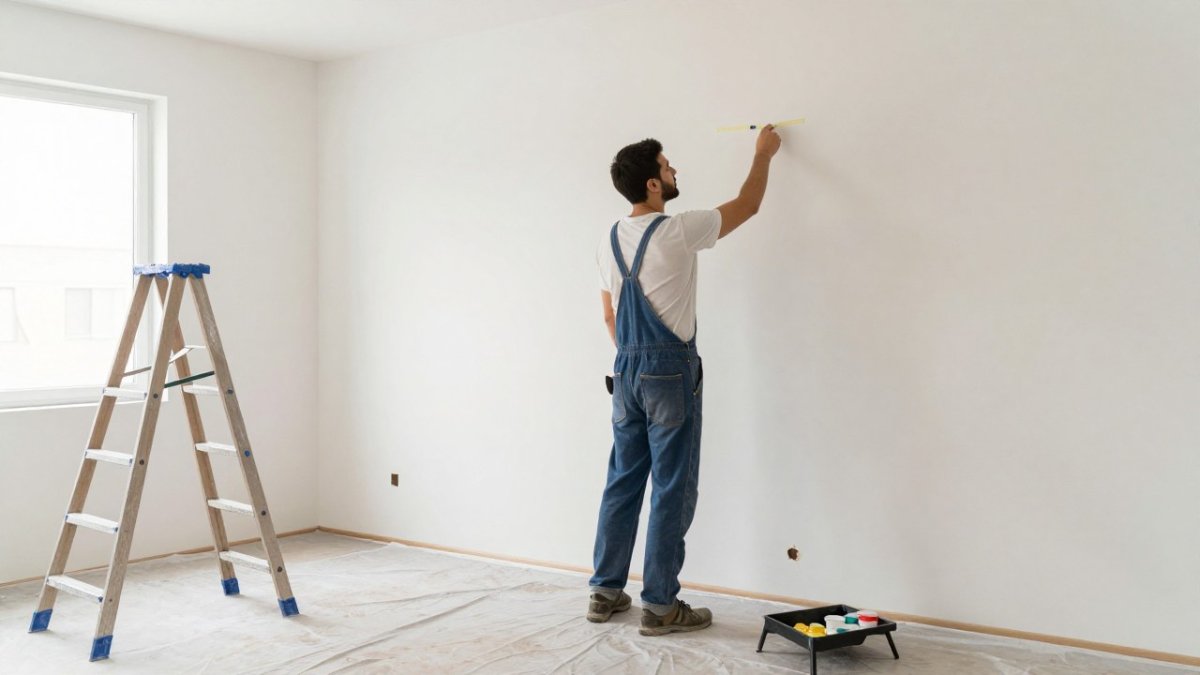
A common mistake is assuming prep is a quick wipe-down. In older homes, it often means scraping loose paint, sanding edges smooth, filling cracks, and spot-priming bare patches. Each step adds hours that a square-foot calculator will not capture. The table below gives working ranges for a standard 12x12 room, so you can add them to your rolling and cut-in estimate.
Production Rates: How Long Each Step Actually Takes
Production rates give you a realistic sense of time per task. These are working ranges, not fixed rules, and they shift with ceiling height and access.
| Task | Approximate Time for a 12x12 Room | What Slows It Down |
|---|---|---|
| Cleaning and wiping walls | 0.5 to 1 hour | Grease, soot, or smoke residue |
| Patching and sanding | 1 to 3 hours | Cracks, holes, plaster repairs |
| Priming bare patches | 0.5 to 1 hour | Large bare areas or stains |
| Masking and drop cloths | 0.5 to 1 hour | Furniture, flooring, lots of trim |
| Cut-in around trim | 1 to 2 hours | Lots of doors, windows, corners |
| Rolling walls, per coat | 2 to 3 hours | Tall walls, furniture in the way |
| Cleanup and touch-ups | 0.5 to 1 hour | Heavy masking, floor protection |
Approximate Time for a 12x12 Room
When comparing quotes, ask how each contractor plans to handle patching and priming on a room with visible damage.
How to Translate Wall Condition into Hours
Before you call anyone, walk each room and note the condition. Most practitioners group walls into three rough tiers:
- Good condition: smooth drywall, no cracks, previously painted within a few years. Prep adds roughly 1 to 2 hours per room.
- Fair condition: minor cracks, small nail holes, some patched areas. Prep adds roughly 2 to 4 hours per room.
- Poor condition: peeling paint, exposed plaster, wallpaper residue, water stains. Prep can add 4 to 8 hours per room, and some walls may need a primer coat over the whole surface.
Wall condition often tells you more about the final labor number than room size alone does. When you compare quotes, ask each contractor which tier they priced and whether patching and priming are included or billed as extras. A quote that states its prep assumptions is easier to trust than one that gives a single number with no scope behind it.
Comparing Labor-Only Quotes: A Scope Checklist
Comparing labor-only quotes is where most homeowners get lost, because the numbers look similar but the scope rarely is. A lower quote often leaves out prep, primer, or a second coat.
Run every bid through this checklist before you decide:
- Does the quote separate labor from paint and materials?
- Is surface prep itemized: cleaning, patching, sanding, priming?
- How many coats are included, and is primer counted separately?
- Are ceilings, trim, doors, and windows priced or excluded?
- Is furniture moving and floor protection included?
- Are major repairs quoted separately or bundled in?
- Is the hourly rate or per-square-foot rate stated clearly?
- Is there a written timeline and start date?
A quote that answers all eight is easy to compare. One that skips half of them is a guess dressed up as a price. To understand what a professional crew should include from start to finish, read our guide on what to expect from professional painters.
Get a Free Estimate for Painting and Floor Work Before You List
Estimating labor to paint interior walls comes down to hours, not guesswork. Measure your wall area, factor in condition and coats, and compare quotes on scope rather than the bottom line alone.
If you are prepping a home to sell or move into, painting and floor work often go together, and bundling them saves disruption. Our interior painting service covers walls, ceilings, trim, and cabinets with free in-home estimates. When your floors need attention too, we handle sanding, refinishing, and repairs in the same visit.
To get a real number instead of an online guess, contact our team for a free in-home estimate.
Most homeowners underestimate prep, and that is exactly where budgets slip. We would rather walk your rooms, flag the patching and priming upfront, and give you a number you can trust. Hardwood Floor Refinishing & Restoration offers free in-home estimates, careful preparation, and dependable scheduling, backed by more than a decade of local work.
Frequently Asked Questions
How is painting labor calculated per square foot?
Wall area is measured as room perimeter times ceiling height, minus doors and windows. Labor-only rates are then applied per square foot of wall surface. Because prep and drying time vary, the same square footage can produce very different labor totals from one home to the next.
Does painting labor include wall preparation?
It depends on the quote. Some contractors list prep as a separate line, while others fold patching, sanding, and priming into a single labor figure. Ask for a written breakdown showing hours for prep, priming, and finish coats. If prep is bundled, ask what level of repair it covers, because filling nail holes and cleaning walls is very different from repairing cracked plaster or water damage.
Does painting a ceiling or trim change the labor estimate?
Yes. Ceilings add surface area and require overhead work, which slows production. Trim, doors, and windows add cutting-in time and often need brushing rather than rolling. A quote for walls only will not match one that includes ceilings and trim, so compare quotes on the same scope. Ask each contractor to list walls, ceilings, and trim separately.
How long does it take to paint interior walls?
Drying time between coats and any curing window for the finish also affect the schedule, so ask for a day-by-day timeline in writing.